Reviewed · HALF-DAY
Crossroads of Humanity: Istanbul Half-Day Tour
Istanbul’s Christian past is scattered across working neighborhoods, quiet courtyards, old walls, and surviving Byzantine churches. This tour gives you a focused way to connect those pieces, from the Orthodox Patriarchate at Fener to the mosaics of Chora and the fish-filled cistern at Balıklı.
I like the private format, since you can ask questions without a large group slowing things down. I also like that transport, church donations, museum entry, parking, and pickup from central hotels are included. The main concern is time: six major stops in four hours is ambitious, and one poor experience involved closed sights and a tour that ended much earlier than expected.
Key points to know
- Private guiding in English or Spanish: You get a more personal visit, with room to ask about theology, art, architecture, and imperial politics.
- A wide spread of Byzantine sites: The route links Fener, Blachernae, Chora, Zeyrek, Fethiye, Balıklı, and St. Sergius and Bacchus.
- Chora is the artistic high point: Its preserved mosaics and frescoes are the reason many people choose this tour.
- Hotel pickup takes planning: Pickup from central hotels can take 45 to 60 minutes, and you must call the local supplier after booking.
- The schedule needs checking: Chora is closed on Wednesdays, and opening conditions can affect what you actually see.
- Best for serious history fans: At $354 per person, this makes the most sense if private transport and a specialist route matter to you.
Why Istanbul’s Christian past needs a dedicated tour
Istanbul is easy to approach through its famous imperial sights: Hagia Sophia, the Blue Mosque, Topkapı Palace, and the Grand Bazaar. Those places deserve their fame, but they can leave you with a narrow picture of the city’s past.
This tour follows another thread. It looks at the city as Constantinople, the capital of the Byzantine Empire and a major center of Orthodox Christianity. You move through churches, monasteries, shrines, and ruins that explain how faith shaped daily life, imperial power, charity, burial customs, and travel.
I like the way the route connects grand ideas with physical remains. At one stop, you may be looking at a monumental church. At another, you may see a spring believed to heal the sick or an underground cistern tied to a miracle involving fish. These details make the past feel less abstract.
You should also set realistic expectations. This is not a relaxed stroll through one compact district. The sights are spread around Istanbul, so the private air-conditioned vehicle matters. It protects you from spending your short visit figuring out connections between sites.
The tour costs $354 per person. That is a serious price for four hours, especially if you are traveling alone. The value improves for a small private party, since the fee includes transport, a guide, parking, entry, donations, and pickup from a central hotel. You are paying for a specialized route and door-to-door help, not just admission to one church.
A few more Istanbul bookings to weigh up
- Istanbul: Fener Balat Half-day Guided Walking Tour
★ 4.9 · 1,711 reviews - Half-Day Bosphorus Cruise to Black Sea from Istanbul with Lunch
★ 4.0 · 187 reviews - Morning Istanbul: Half-Day Tour with Blue Mosque, Hagia Sophia, Hippodrome and Grand Bazaar
★ 4.5 · 103 reviews
Fener and the Orthodox Patriarchate
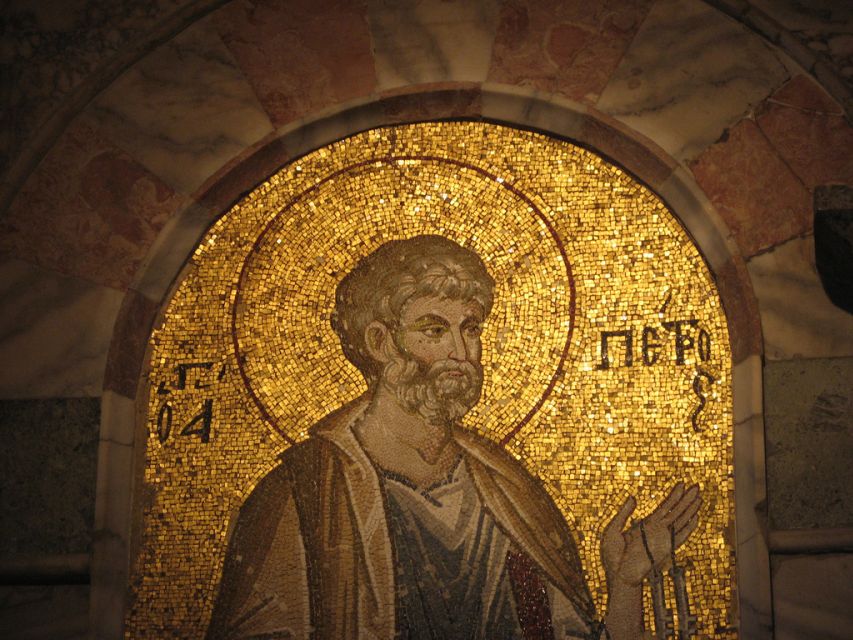
The tour begins at the Patriarchate at Fener, the spiritual center of Orthodox Christianity. This is the right place to start because it gives the rest of the route a clear purpose.
Your guide explains Constantine the Great’s role in the Christian Roman Empire and the later importance of Constantinople as a church center. The story is not simply about a ruler choosing a new faith. It is also about how the location of the imperial capital helped shape Christianity across the eastern Roman world.
Fener adds a human scale to that story. The Patriarchate is not just an abandoned relic. It remains connected to Orthodox religious life, which helps you see the city as a place where old institutions have survived amid centuries of political change.
I would listen closely here rather than rushing to take pictures. The background given at the first stop affects everything that follows. Without it, the churches can look like disconnected ruins. With it, you begin to understand why emperors, patriarchs, monks, pilgrims, and ordinary worshippers all mattered to the city’s story.
Panagia of Blachernae and the healing spring
The Church of Panagia of Blachernae brings you to one of the tour’s more personal religious traditions. The site is associated with the Hagiasma, or holy-water fountain, which is believed to cure health problems.
The story also connects the spring with the emperor, who came for cleansing. That detail is useful because it shows how Byzantine religion crossed the usual line between public ceremony and private hope. An imperial visit to a healing spring made the sacred place part of the city’s political and spiritual life.
You may find this stop more meaningful if you approach it as a living religious tradition rather than as a simple monument. The water, the story, and the setting help explain why pilgrimage sites mattered so much.
The practical limit is that the experience depends on what is open and accessible during your visit. The supplied information does not promise a particular ritual or amount of time at the spring, so treat the stop as an introduction to the site and its tradition rather than a guaranteed healing experience.
Chora and the Byzantine art you came to see
St. Savior in Chora, also known as the Kariye Museum, is likely to be the artistic centerpiece. The building began as a Byzantine monastery dedicated to Jesus, and its surviving mosaics and frescoes are noted for their quality and preservation.
This is where the tour moves beyond broad political history and gives you close contact with Byzantine religious art. Mosaics and frescoes were not decoration in the modern sense. They helped worshippers understand biblical scenes, sacred figures, and the Christian story through images placed inside the church.
Your guide can also help you read the architecture and artwork as part of one program. Look for the way images occupy domes, walls, and passageways. The value of a guide here is not only naming what you see. It is explaining why the scenes were placed where they were and how the decoration worked inside a monastery church.
Plan this stop carefully. Chora is closed on Wednesdays, so Wednesday is a poor choice for this itinerary if seeing the interior matters to you. Opening conditions can change, and one past booking ended badly when the scheduled visits were closed. Call the supplier after booking and confirm what will be open on your date.
If Chora cannot be visited, the tour loses one of its strongest reasons for being. The other sites still offer architectural and religious interest, but the mosaics and frescoes are a major part of the appeal.
A different side of Istanbul on the same trip:
- Istanbul: Bosphorus Dinner Cruise & Show with Private Table
★ 4.8 · 44,561 reviews - Istanbul: Daytime or Sunset Sightseeing Cruise & Audio Guide
★ 4.8 · 14,430 reviews - Istanbul: Bosphorus Dinner Cruise with Turkish Night Show
★ 4.8 · 10,127 reviews - Best of Istanbul 1, 2 or 3-Day Private Guided Istanbul Tour
★ 5.0 · 8,922 reviews
Pantocrator, or Zeyrek, and the scale of a monastery complex
Pantocrator, now known as Zeyrek, gives you a look at Byzantine planning on a much larger scale. This is not just one church building. The complex included churches, funerary chapels, baths, a hospice for older people, and a hostel for people arriving in the city.
That list tells you how a major religious institution worked. It served worshippers, the dead, the sick, older residents, and people on the road. A monastery could be a place of prayer, but it could also function as a center of care and hospitality.
The site is described as labyrinthine, so allow your guide to organize the visit. You may not grasp the full plan at a glance. The interest lies in piecing together how the parts related to one another.
I especially like this stop for readers who want more than beautiful surfaces. Zeyrek shows the practical side of Byzantine Christianity. It was built into the life of the city, not sealed away from it.
The tradeoff is that ruins and altered spaces require imagination. You will not get the same polished visual impact as at a well-preserved interior. The guide’s explanation matters here, since the complex’s purpose is easier to understand when someone points out the connections.
Fethiye and the art of the Paleologan Age
The Church of St. Mary Pammacaristos, now called Fethiye, brings you to the remains of an 11th-century church. Its decoration reflects the aesthetic refinement of the Paleologan Age, the later period of Byzantine rule.
This stop also carries political weight. After the Ottoman conquest, the building served as a home for the Patriarchate. That later use adds another layer to the site. You are not looking at a monument with only one chapter. Its meaning shifted as the city changed hands and religious institutions adapted.
The remains may appeal most to people who enjoy architectural detail. Look closely at the surfaces, proportions, and fragments rather than expecting one complete, easily understood building. The charm here comes from reading what remains.
Because the route covers several sites, your time at Fethiye may be limited. That is part of the basic compromise of a half-day tour. You see more places than you could manage alone, but you do not have hours to linger at every wall or photograph every detail.
Balıklı and the miracle of the golden fish
At Balıklı, the focus shifts from imperial architecture to an underground cistern associated with Zoodochos Pege. The cistern contains goldfish linked to the miracle of the fish.
This is one of the route’s more unusual stops. The fish story gives the site a memorable local tradition, while the underground setting adds a strong sense of place. It also shows how sacred sites often preserve stories through physical details that are easy to remember and pass from one generation to the next.
You may find this stop especially useful after the larger churches. It offers a change of pace and helps show that Christian history in Istanbul is not limited to grand domes and court ceremonies. Springs, cisterns, animals, and healing stories all belong to the record.
The information provided does not specify how long you spend underground or describe the exact viewing conditions. Expect an introduction to the site rather than a long independent visit.
St. Sergius and Bacchus, the small church with a big connection
The final architectural highlight is the Church of St. Sergius and Bacchus. It is presented as a prime example of Byzantine architecture and is often compared with Hagia Sophia because of its form.
That comparison is useful, but you should not expect a second Hagia Sophia. The point is the connection. St. Sergius and Bacchus predates Hagia Sophia and helps you see how Byzantine architects developed ideas about space, structure, and worship before the better-known imperial church was built.
I like stops such as this because they make famous monuments easier to understand. Instead of treating Hagia Sophia as a sudden miracle, you can see it as part of a longer process of experimentation and refinement.
The church also gives the itinerary a satisfying architectural finish. After the Patriarchate, holy spring, monastery, mosaics, and cistern, you return to the question of how Byzantine buildings were designed. The route ends with a clear link between a smaller church and Istanbul’s most famous Byzantine monument.
What the private transport and timing really mean
The tour lasts four hours, but hotel pickup can take 45 to 60 minutes. Pickup is offered between 8:00 and 9:00 in the morning or between 13:00 and 14:00 in the afternoon, depending on your hotel and booking time.
That means you should not treat four hours as four full hours at the monuments. The route includes driving, pickup, drop-off, parking, and several stops. If you are collected at 8:30, for example, part of the morning has already gone before the first visit begins.
Private air-conditioned transport is still a real advantage. The sites are spread around Istanbul, and a private vehicle avoids the extra work of arranging taxis or public transport between lesser-known churches. It also lets the guide manage the route in a way that a self-guided visitor might find difficult.
After booking, you need to call the local supplier to learn the exact pickup time and confirm shuttle availability. This is not a step to skip. Pickup is only offered from centrally located hotels, and hotels outside the service area may be assigned an alternative meeting point.
The guide languages are English and Spanish. A previous tour led by Ertuğrul, with an assistant, was praised for its calm manner, patience, and personal feel. That gives you a useful idea of the best possible format, though a particular guide cannot be guaranteed unless the supplier confirms it.
Is $354 per person a fair price?
At first glance, $354 per person is expensive for a half-day. You should compare it with what the fee covers rather than judging it against a basic walking tour.
Included are private air-conditioned transportation, private guiding in your chosen language, museum entry, donations to churches, parking, value-added tax, and pickup and drop-off from central hotels. The price also buys a route that would be awkward to arrange independently, especially if you do not speak Turkish or know the locations.
For one person, the cost is hard to justify unless this specific Christian and Byzantine focus is central to your Istanbul plans. For two or more people sharing a private arrangement, it becomes easier to see the value, particularly if convenience matters.
Still, do not pay this amount without confirming the schedule. A past booking involved closed sights, a late arrival after pickup, and a visit that ended at 11:45 despite the expected three to four-hour duration. That experience is a warning to verify opening conditions, pickup time, and the planned stops before the day begins.
Free cancellation up to 24 hours before the tour and reserve-now, pay-later booking reduce the financial risk. They do not solve the main issue, which is making sure the route will operate as expected on your date.
Who should book this Istanbul half-day tour?
I would choose this tour if you have already seen Istanbul’s headline monuments and want a more focused look at Orthodox Christianity and Byzantine architecture. It also suits you if you prefer a private guide and do not want to coordinate transport between scattered sites.
The route works well for history fans, church architecture enthusiasts, and visitors who want context rather than a quick photo stop. It is also useful if you have only half a day but still want to see several places connected by one theme.
I would hesitate if you mainly want a slow visit to one major monument. Four hours is packed, and the route may feel hurried if you want extended time for photography or quiet reflection. I would also avoid Wednesday unless the supplier confirms that Chora’s closure will not undermine your plans.
Bring your passport or ID card. Pets and smoking are not allowed. Most important, call after booking and confirm the exact timing, pickup point, language, and site availability.
Should you book it?
Book this tour if the Byzantine and Orthodox story of Istanbul is high on your list and you value a private vehicle, a dedicated guide, and a route beyond the standard sightseeing circuit. The churches and shrines offer a more unusual view of the city, and Chora, Zeyrek, Balıklı, and St. Sergius and Bacchus each add something different.
Skip it if $354 feels too high for a four-hour outing, if you want an unhurried pace, or if you cannot confirm that the key sites will be open. The tour can be excellent with a careful schedule and a strong guide, but its success depends heavily on logistics. Confirm those details first, then book it for a thoughtful look at Istanbul’s Christian past.
FAQ
How long is the Crossroads of Humanity tour?
The stated tour duration is four hours. Hotel pickup may take 45 to 60 minutes, so the total time connected with pickup and drop-off can be longer.
What languages are available?
Private guiding is available in English and Spanish.
Is hotel pickup included?
Yes. Free pickup and drop-off are included for centrally located Istanbul hotels. If your hotel is outside the service area, the local supplier will provide an alternative meeting point.
When does hotel pickup take place?
Pickup is offered between 08:00 and 09:00 for a morning tour or between 13:00 and 14:00 for an afternoon tour. The exact time depends on your hotel and booking.
Is Chora open every day?
Chora is closed on Wednesdays. Check the operating status for your date before booking, especially if seeing its mosaics and frescoes is important to you.
What is included in the price?
The price includes private air-conditioned transportation, private guiding, church donations, museum entrance, parking, value-added tax, and pickup and drop-off from central hotels.
Can I cancel for a full refund?
You can cancel up to 24 hours in advance for a full refund.
What should I bring?
Bring your passport or ID card. Pets and smoking are not allowed on the experience.
Recently added in Istanbul
- Two (2) Days Istanbul Old City and Two Continents Walking Tour★ 5.0 · 6 reviews
- istanbul old city private tour★ 5.0 · 19 reviews
- Private Guided Tour: Discovering Istanbul★ 4.5 · 9 reviews
- Istanbul Airport (IST) To Hotels Transfer★ 5.0 · 80 reviews
- Best Of İstanbul Europe Side In One Day★ 5.0 · 10 reviews
- 2 Days Cappadocia Tour from Istanbul with Optional Balloon★ 5.0 · 10 reviews
- Hagia Sophia Private Skip The Ticket line guided Tour★ 4.5 · 17 reviews
- historical peninsula walking tour★ 5.0 · 6 reviews
Half-Day, compared.
Half-Day Bosphorus Cruise to Black Sea from Istanbul with Lunch
Read our review →
Morning Istanbul: Half-Day Tour with Blue Mosque, Hagia Sophia, Hippodrome and Grand Bazaar
Read our review →
Half-Day Cruise and Cable Car to Pierre Loti Hill
Read our review →
Imperial Istanbul Half-Day Tour: Hagia Sophia and Grand Bazaar
Read our review →